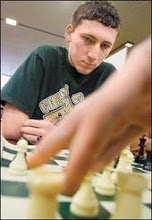
The following game was submitted by Mathew Jacob and is a great example of pins, pins, and more pins. Some threatened, some actual, all of them scary.
Showing posts with label Annotations. Show all posts
Showing posts with label Annotations. Show all posts
Wednesday, October 27, 2010


Sunday, September 19, 2010
The Adventure Continues, Video: Laugher/Fundamentals
So I decided to post a game of decidedly lower quality this time. Partially just so I post something and partially because it illustrates fundamentals pretty well. As I state in the video, I am going to start to check out some of the clubs in the area this week, so hopefully I can find one to regularly attend. I might post another video later in the week, a good game that ends after an abrupt error. As always, I welcome any comments and suggestions.
Wednesday, June 23, 2010
Vs. J. Zhang: Queens and Pawns and Diagonals, Oh My!
I did moderately well at the Iowa City Open, with 3.0/4.0. My horrible lack of sleep the night before made things difficult, luckily all four games were pretty straightforward. It also helped that the tournament was only about two blocks from where I live, so I got to go home and rest between rounds. In the third round, I played Jiahua Zhang, a young player who in early 2009 I told Hank Anzis was going to be a strong player sometime in the next few years. Here it is a year and a half later, over 600 points later for Jiahua, and him coming off a nice draw against an expert, I knew I had my work cut out for me. The opening and middlegame of this game were nearly nonexistent. It felt like it just went 1. e4 c5 2. Rxe8+ and endgame. Because of this, there was obviously no room for a flashy attack. So I just did what I always do when I'm playing a dangerous young player, I just out-endgame them. For all my flashy attacks, I actually think my chances are better in any given ending than any given middlegame. Don't get discouraged by this video being about endgames, I still try to keep it interesting by adding in lots of pretty colors. Enjoy and share your thoughts in the comments!
Thursday, June 3, 2010
Video: Against Steiner: How do you reach these positions, you maniac?
Finally I have returned to making video posts. I had a rather successful North American Open in Stillwater, OK. I scored a solid 6.0/10.0. Yes, that's right, out of 10 rounds. With 3 wins, 4 draws, 1 loss, and 2 byes, I felt like I played pretty well. Of my games, I believe this one to be the most entertaining, played against expert Tim Steiner in round 7. Since when I made this video, it was over 20 minutes, I chopped off most of the opening, since it was just a ...Bd6 Evans Gambit. That cut it down to 16 minutes of listening to me drone on. If you want a pgn of the game in its entirety with my notes, email me and I will send you a copy.
Friday, April 16, 2010
Vs Tyagi: Light Square Attack
As the poll said, you wanted middlegame ideas, so I chose a game in which the weakness of a certain color of square makes a large difference in the outcome of the game. Enjoy!
Thursday, April 15, 2010
Maybe in a day or so?
Sorry everybody. I have the next game ready for video, but I have not been feeling well enough to actually record it. For now, I will post the game in pgn form (for some reason you can't embed files on Blogger) and you can save the text as a pgn and view it if you would like. Once I get feeling a bit better I will turn it into a video post for those of you that are lazy or don't have a pgn viewer. What is below is more or less what I will say in the video, so if you want a sneak preview of it then you can go through what is below.
[Event "Cedar Rapids Leatherjackets"]
[Site "Cedar Rapids"]
[Date "????.??.??"]
[Round "?"]
[White "Tyagi"]
[Black "Madison"]
[Result "0-1"]
[ECO "A40"]
[Annotator ",Jeremy"]
[PlyCount "36"]
{Annotated by Jeremy!} 1. d4 e6 2. c4 b6 3. Nc3 f5 4. g3 Bb7 5. Nf3 Nf6 6. Bg2
Be7 7. O-O O-O 8. b3 {This is where we leave my database, although I am sure ..
.d6 has been played before.} d6 9. Bb2 ({The main alternative is:} 9. d5 e5 {
The e6 square is where the entire game revolves.} 10. Ng5 Bc8 11. Ne6 Bxe6 {
Black has to be careful not to lose this exchange with the light squared
bishops off the board.} 12. dxe6 c6 {Will this pawn mean victory or defeat?})
9... Nbd7 $2 {Sometimes development is wrong.} (9... d5 {
Immediately was much stronger.}) 10. Nd2 $2 (10. Ng5 {Outright wins a pawn.}
Bxg2 11. Kxg2) 10... Bxg2 11. Kxg2 d5 {Now the fight is being taken to white.}
12. e3 {This light square complex is a lot weaker without the light squared
bishops on the board, which is why black was more than happy to trade them off.
The difference is that the light squared weakness in black's position are in
an area that cannot be exploited anytime soon. White's light square weaknesses
are right around the king, where several black pieces can immediately attack
them.} c6 {
Indirectly supports the attack by tightening the grip on the light squares.}
13. Nf3 {Eyeing e5, but this game is about light squares.} Bd6 {"Defends" the
e5 square, but more importantly is aiming at the pawns in front of the enemy
king.} 14. Qc2 {An attempt at fighting for e4, but this needed to be done
earlier with the Knight on d2, so that f3 and e4 could be tried.} Ne4 {
Now there is just not enough time for white to get in all of the moves they
want. Black has an advantage no matter how you slice it.} 15. Nd2 {
f3 is the obvious followup, so what should black do?} Qg5 {Trying to get the
knee-jerk f4 played, when there are more permanent weaknesses around the white
king. This also sets a most devious trap on f3.} 16. f3 (16. f4 Qg6 {The idea i
s to throw the h-pawn to break up the pawns in front of the white king. If
Rook support is needed on the h-file, Kf7 is perfectly safe to play followed
by doubling on the h-file.}) 16... Nxg3 {Black is completely won now. White's
only option for continuing the game is to move the f1 rook and just hope.} 17.
f4 (17. hxg3 Qxg3+ 18. Kh1 Qh2#) (17. Rfe1 Ne4+ 18. Kf1 Nxc3 19. Qxc3 Bxh2 {
With a winning edge for black.}) 17... Nxf1+ {
But that's just losing for black right?} 18. fxg5 Nxe3+ {Black has seen one
move more than white, and that is the cause of this win for black. Notice that
black did not really have a particularly clear plan until the exchange of
light squared bishops, when the plan of light squared play became simple to
find. These are the kinds of things to look for in your own games. Slight
differences can radically change the correct ideas.} 0-1
[Event "Cedar Rapids Leatherjackets"]
[Site "Cedar Rapids"]
[Date "????.??.??"]
[Round "?"]
[White "Tyagi"]
[Black "Madison"]
[Result "0-1"]
[ECO "A40"]
[Annotator ",Jeremy"]
[PlyCount "36"]
{Annotated by Jeremy!} 1. d4 e6 2. c4 b6 3. Nc3 f5 4. g3 Bb7 5. Nf3 Nf6 6. Bg2
Be7 7. O-O O-O 8. b3 {This is where we leave my database, although I am sure ..
.d6 has been played before.} d6 9. Bb2 ({The main alternative is:} 9. d5 e5 {
The e6 square is where the entire game revolves.} 10. Ng5 Bc8 11. Ne6 Bxe6 {
Black has to be careful not to lose this exchange with the light squared
bishops off the board.} 12. dxe6 c6 {Will this pawn mean victory or defeat?})
9... Nbd7 $2 {Sometimes development is wrong.} (9... d5 {
Immediately was much stronger.}) 10. Nd2 $2 (10. Ng5 {Outright wins a pawn.}
Bxg2 11. Kxg2) 10... Bxg2 11. Kxg2 d5 {Now the fight is being taken to white.}
12. e3 {This light square complex is a lot weaker without the light squared
bishops on the board, which is why black was more than happy to trade them off.
The difference is that the light squared weakness in black's position are in
an area that cannot be exploited anytime soon. White's light square weaknesses
are right around the king, where several black pieces can immediately attack
them.} c6 {
Indirectly supports the attack by tightening the grip on the light squares.}
13. Nf3 {Eyeing e5, but this game is about light squares.} Bd6 {"Defends" the
e5 square, but more importantly is aiming at the pawns in front of the enemy
king.} 14. Qc2 {An attempt at fighting for e4, but this needed to be done
earlier with the Knight on d2, so that f3 and e4 could be tried.} Ne4 {
Now there is just not enough time for white to get in all of the moves they
want. Black has an advantage no matter how you slice it.} 15. Nd2 {
f3 is the obvious followup, so what should black do?} Qg5 {Trying to get the
knee-jerk f4 played, when there are more permanent weaknesses around the white
king. This also sets a most devious trap on f3.} 16. f3 (16. f4 Qg6 {The idea i
s to throw the h-pawn to break up the pawns in front of the white king. If
Rook support is needed on the h-file, Kf7 is perfectly safe to play followed
by doubling on the h-file.}) 16... Nxg3 {Black is completely won now. White's
only option for continuing the game is to move the f1 rook and just hope.} 17.
f4 (17. hxg3 Qxg3+ 18. Kh1 Qh2#) (17. Rfe1 Ne4+ 18. Kf1 Nxc3 19. Qxc3 Bxh2 {
With a winning edge for black.}) 17... Nxf1+ {
But that's just losing for black right?} 18. fxg5 Nxe3+ {Black has seen one
move more than white, and that is the cause of this win for black. Notice that
black did not really have a particularly clear plan until the exchange of
light squared bishops, when the plan of light squared play became simple to
find. These are the kinds of things to look for in your own games. Slight
differences can radically change the correct ideas.} 0-1
Thursday, March 18, 2010
New Video: Vs Sobo; When you are in trouble
Back after a bit of a break from making videos. I got bit by the MMO bug for a while, and haven't played much chess, so coming up with material for videos is a bit difficult. It was kind of funny I missed a mate in 1 while recording the video so I had to add in text over the analysis near the end. As always, I welcome suggestions for future videos or comments on them.
Tuesday, March 2, 2010
New Video: Drake Chess Festival vs. Bernat
Here is a new video everyone! I scored 3.0/4.0 in the Open of the Drake Chess Festival, increasing my USCF to 1935, the highest it has been in nearly 2 years. I made a video of my last round game, which was the best played of the four. I also fiddled with the video settings some more to try and get more of a square look to the board. As always, I welcome any comments here or on the forum.
Monday, February 22, 2010
In the style of the old Masters
Game 3 of my match against George Eichhorn was an exceptionally interesting game to look at. I made a video post of some of my analysis for you all to look at and comment on. The match itself ended in a 2-2 draw. Home field advantage seemed insurmountable in this match, with George winning the two games in Stratford and me winning the two in Iowa City. I want to thank Jason for his assistance in verifying that the computers can't play the position after the sacrifice correctly. This game might end up being one of my crown jewels, so I hope that it can generate some discussion in the comments.
Thursday, February 11, 2010
New Video - Madison-Hodina
As requested by Jason, I have annotated the game I played in round 4 of the Cedar Rapids Leatherjackets tournament against Jim Hodina. I messed around with the capturing again, so it should show up better now. Hopefully you cannot hear how stuffed up I was when I recorded this earlier today. As always, I welcome any comments on the game, the annotations, or the video itself. I uploaded straight onto Blogger this time instead of onto Veoh since the video has been in processing all day on Veoh with no sign of finishing any time soon.
Monday, February 1, 2010
First Video Annotations
Watch Chess Game Analysis in Sports | View More Free Videos Online at Veoh.com
Ok, so I finally managed to make the video and get it edited sufficiently well. On the plus side, since this is the first one, it can only get better than this. Please let me know what you think so that I can make more like this or not.
Saturday, November 28, 2009
35. ...Ra7 36. Re8+ and a game by request

This felt rather forced, so luckily I didn't have to think much about it. Next move is coming along on Tuesday. Now, since a game from DSM or Ames was requested, I dug around and managed to find an actually instructive game from the Des Moines Fall Classic. It is my round 1 game against Gerald Hawkins, in which white relentlessly attacks and black quickly finds himself unable to defend. The game reminds me of looking through old games from the 1800s where one player never really sees their impending doom until it is already too late. Please let me know if you like seeing the games in this format or if you prefer my previous method of using diagrams once in a while.
Thursday, July 30, 2009
And finally, here is the game.
Played at the Training Quad tournament in Marshalltown. I got some revenge for my loss at the State Championship.
Madison - Eichhorn
1. d4 d5 2. c4 e5!?
Ah, the Albin Countergambit. Nary a normal position ahead.
3. dxe5 d4 4. a3 Be6 5. Nf3 Nc6 6. e3
So far so good. White usually can't hold on to the extra pawn, but instead tries to generate play while black takes the time to regain the pawn on e5. e3 threatens to take on d4, which would have white up two pawns and e5 would be tough to take back (which I assume is why e3 is the book move).
6. ...dxe3 7. Qxd8+ Rxd8 8. Bxe3 Nge7 9. Nc3 Ng6 10. Nb5 Rd7
I had been out of book since 4. ...Be6, but Master level games have actually made it to this position before. All of them I could find ended up in draws though.
11. Rd1!N

Only later to find out that the book move was an immediate Nbd4. Haven't found any previous games with this, but I assume it has been played. I figure this is slightly stronger since it challenges the d-file and also really strains the rook on d7, but what do I know?
11. ...a6 12. Nbd4 Ncxe5 13. Nxe5 Nxe5 14. Bf4
Now I am unsure of this move. It is hard to say whether the black knight is worse on e5 or g6. I just wanted to add pressure to c7 and also concluded that the knight would be less active on g6.
14. ...Ng6 15. Nxe6 fxe6
Another point of Bf4 was to lay the easily avoided trap 15. ...Nxf4?? 16. Nxf4! winning a piece.
16. Be3 Be7
This is where it gets a little tricky. During the game I had seen the idea Bf8-e7-f6, and had trouble figuring out how to deal with it. I spent a few minutes mulling it over and then played...
17. Be2 Bf6 18. b3 Bc3+

There is a pretty critical decision here: play Bd2, several exchanges and can I win this endgame? Doubtful despite having the better of it and a pretty safe draw. Or I can play Kf1 and walk into the uncharted desert.
19. Kf1 Rf8
During the game this felt like a mistake to me, but I can't really find anything particularly wrong about it.
20. Rxd7 Kxd7 21. Bd3 e5?!
The idea is to anchor the bishop on d4 and/or possibly play for e4 at some point to disrupt the white pieces. Personally, I prefer ...Ne7 and trying to liquidate the queenside. White can't take on h7 because of ...g6 and ...Rh8.
22. Bxg6!
You might be saying, "But Jeremy, the two bishops is an advantage, especially with an open center and in an endgame!" To which I respond: I like my chances to win better and my chances to lose on a downward spiral when my opponent has shattered pawns and all else is equal. All I have to do is play a flawless endgame, and how hard could that be?
22. ...hxg6 23. Ke2 Ke6 24. Rd1
This rook is a beast on d1.
24. ...b6 25. f3 a5 26. c5?
It looks strong, but simply capturing and ...Rb8 suddenly puts the squeeze on white.
26. ...b5?

27. c6!
This is one of those subtle things that you get to play once in a while. Namely, if my rook is a beast on d1, it must be a demon on d7.
Rh8 28. h3 a4 29. bxa4 bxa4 30. Rd7 Ba5 31. Bd2 Bxd2?
This is the decisive error. From here I felt that the rook ending was completely won for me. I had been calculating 31. ...Bb6 the whole time to close counterplay on the b-file, to which I intended to respond 32. Bb4 with the idea of moving my king up and creating more threats. I can take the pawns at my leisure I think.
32. Kxd2 Rb8 33. Rxc7 Kd6 34. Rb7!
Forces the black rook off of an active file. 34. ...Rxb7?? is a lost king and pawn ending, so...
34. ...Rc8 35. Rxg7 Kxc6 36. Rxg6+ Kb5

37. Re6 Rc5 38. g4
I have all the time in the world to gradually advance these pawns, while black is suffering from piece paralysis.
38. ...Kc4 39. Rb6!
Buying as much time as possible.
39. ...Rd5+ 40. Ke2 Kc3 41. Rb4 Rd2+ 42. Ke3 Rd3+ 43. Kf2 Rd4 44. Rb5 Rd2+ 45. Kg3 e4 46. fxe4 Rd3+ 47. Kh4 Kc2 48. g5 Rxa3 49. g6 Rb3
And now for the finishing blow...

50. g7! Rxb5 51. g8=Q Rb3 52. Qc4+ The last pawn about to fall, black calls it a day. 1-0
Madison - Eichhorn
1. d4 d5 2. c4 e5!?
Ah, the Albin Countergambit. Nary a normal position ahead.
3. dxe5 d4 4. a3 Be6 5. Nf3 Nc6 6. e3
So far so good. White usually can't hold on to the extra pawn, but instead tries to generate play while black takes the time to regain the pawn on e5. e3 threatens to take on d4, which would have white up two pawns and e5 would be tough to take back (which I assume is why e3 is the book move).
6. ...dxe3 7. Qxd8+ Rxd8 8. Bxe3 Nge7 9. Nc3 Ng6 10. Nb5 Rd7
I had been out of book since 4. ...Be6, but Master level games have actually made it to this position before. All of them I could find ended up in draws though.
11. Rd1!N

Only later to find out that the book move was an immediate Nbd4. Haven't found any previous games with this, but I assume it has been played. I figure this is slightly stronger since it challenges the d-file and also really strains the rook on d7, but what do I know?
11. ...a6 12. Nbd4 Ncxe5 13. Nxe5 Nxe5 14. Bf4
Now I am unsure of this move. It is hard to say whether the black knight is worse on e5 or g6. I just wanted to add pressure to c7 and also concluded that the knight would be less active on g6.
14. ...Ng6 15. Nxe6 fxe6
Another point of Bf4 was to lay the easily avoided trap 15. ...Nxf4?? 16. Nxf4! winning a piece.
16. Be3 Be7
This is where it gets a little tricky. During the game I had seen the idea Bf8-e7-f6, and had trouble figuring out how to deal with it. I spent a few minutes mulling it over and then played...
17. Be2 Bf6 18. b3 Bc3+

There is a pretty critical decision here: play Bd2, several exchanges and can I win this endgame? Doubtful despite having the better of it and a pretty safe draw. Or I can play Kf1 and walk into the uncharted desert.
19. Kf1 Rf8
During the game this felt like a mistake to me, but I can't really find anything particularly wrong about it.
20. Rxd7 Kxd7 21. Bd3 e5?!
The idea is to anchor the bishop on d4 and/or possibly play for e4 at some point to disrupt the white pieces. Personally, I prefer ...Ne7 and trying to liquidate the queenside. White can't take on h7 because of ...g6 and ...Rh8.
22. Bxg6!
You might be saying, "But Jeremy, the two bishops is an advantage, especially with an open center and in an endgame!" To which I respond: I like my chances to win better and my chances to lose on a downward spiral when my opponent has shattered pawns and all else is equal. All I have to do is play a flawless endgame, and how hard could that be?
22. ...hxg6 23. Ke2 Ke6 24. Rd1
This rook is a beast on d1.
24. ...b6 25. f3 a5 26. c5?
It looks strong, but simply capturing and ...Rb8 suddenly puts the squeeze on white.
26. ...b5?

27. c6!
This is one of those subtle things that you get to play once in a while. Namely, if my rook is a beast on d1, it must be a demon on d7.
Rh8 28. h3 a4 29. bxa4 bxa4 30. Rd7 Ba5 31. Bd2 Bxd2?
This is the decisive error. From here I felt that the rook ending was completely won for me. I had been calculating 31. ...Bb6 the whole time to close counterplay on the b-file, to which I intended to respond 32. Bb4 with the idea of moving my king up and creating more threats. I can take the pawns at my leisure I think.
32. Kxd2 Rb8 33. Rxc7 Kd6 34. Rb7!
Forces the black rook off of an active file. 34. ...Rxb7?? is a lost king and pawn ending, so...
34. ...Rc8 35. Rxg7 Kxc6 36. Rxg6+ Kb5

37. Re6 Rc5 38. g4
I have all the time in the world to gradually advance these pawns, while black is suffering from piece paralysis.
38. ...Kc4 39. Rb6!
Buying as much time as possible.
39. ...Rd5+ 40. Ke2 Kc3 41. Rb4 Rd2+ 42. Ke3 Rd3+ 43. Kf2 Rd4 44. Rb5 Rd2+ 45. Kg3 e4 46. fxe4 Rd3+ 47. Kh4 Kc2 48. g5 Rxa3 49. g6 Rb3
And now for the finishing blow...

50. g7! Rxb5 51. g8=Q Rb3 52. Qc4+ The last pawn about to fall, black calls it a day. 1-0
Sunday, July 12, 2009
Finally a tournament, and a good game from it!
Here is a game I played from the CCCP July Open, held yesterday in Ankeny. I did not use computer analysis for this, so feel free to question my analysis. Make sure to pay special attention to this endgame after move 25:
Walker - Madison
CCCP July Open, Round 4
1. e4 e5 2. Nf3 Nc6 3. Bb5 a6 4. Bxc6 dxc6 5. Nc3 Bg4?!
This is playable, but it gives up the bishop pair right away, which is black's only advantage.
(5... f6)
6. h3 Bh5?
I show that I am still a bit unfamiliar with Ruy ideas.
7. g4! +/- Bg6 8. Nxe5 Bc5
The idea is Bxf2+ Kxf2 Qd4+ to regain the piece on e5.
9. Nxg6 hxg6 10. Qe2 Nf6 11. d3
(11. e5!? Nd5 12. Ne4 Bb6 13. c4 Ne7 +/-)
11. ...Qd7 12. Be3?
(12. g5? Ng4!! 13. Nd1 (13. f3 Nf2!) 13... Ne5 Is unclear, but black has play for the pawn.)
12... Bxe3 13. Qxe3 Nxg4!

Got my pawn back.
14. Qf3
Forces the retreat of the knight.
14. ...Nf6
(14... O-O-O?? 15. hxg4 +-)
15. O-O-O O-O-O 16. e5 Nd5 17. Ne4!? Qf5
Black sees that the weakness of the white kingside pawns will give good chances without the queens on.
18. Qxf5+ gxf5 19. Ng5 Rdf8
(19... f6?? 20. Nf7)
20. Rde1 Nf4

Now the ...f6 idea is playable, which would win the h-pawn.
21. e6?! = fxe6 22. Nxe6 Nxe6 23. Rxe6 Re8 24. Rxe8+ Rxe8 25. Kd2

Draw offered. I would have accepted, but those kingside pawns look so weak. See if you can figure out a plan to try for a win and then look at what I did.
25 ...Kd7 26. Rg1 Re7 27. Rg5 Ke6 28. Rg3
(28. Ke3?? Kf6+ 29. Kf4 Re2 -+)
28... Kf6 29. h4?!
To stop ...g5, but I think that Re3! is the correct move.
(29. Re3 Rxe3 (29...Rf7 +=) 30. Kxe3 Kg5 31. Kf3 Kh4 32. Kg2 Looks threatening, but white can
make a passer on the queenside which the black king can not reach.)
29... g6 30. Re3?
Now this is a mistake because it wastes a key tempo.
(30. f4! And this should end up drawn.)
30... Rh7! 31. Rh3

Forced.
31. ...f4!! -+
Cuts off the white king, prevents the white rook from going back to e3, and
allows the black king to advance to f5, which will be important in a few moves.
32. Ke2
The only other try is to play on the queenside, but black's pieces
are much more active, so black should still if nothing else have the better
end of a draw.
32. ...Kf5 33. Kf3 g5!
The reason ...f4!! and ...Kf5 needed to be played first. Now white cannot take with check.
34. Rh1 Rxh4 35. Re1
(35. Rxh4 gxh4 36. Kg2 Kg4 37. f3+ Kg5 Now when things start to look dangerous the
black king will run back and devour the white pawns and win.)
35... Rh2!
Much stronger than the obvious ...g4+
36. Re8 g4+ 37. Ke2 g3
Forces the win of the f2 pawn and game.
38. Rf8+

38. ...Ke5 39. d4+ Ke4 40. Re8+ Kxd4 41. Rd8+ Kc5 42. Rg8 Rxf2+ 43. Kd3 g2 44. Rg5+ Kb6 45. Rg4 f3
(45... Rf3+ Is technically more accurate. 46. Ke4 Rg3 47. Rxg3 fxg3)
46. Rg3
(46. Ke3 Rf1)
46... Rf1

And white resigned. 0-1
Walker - Madison
CCCP July Open, Round 4
1. e4 e5 2. Nf3 Nc6 3. Bb5 a6 4. Bxc6 dxc6 5. Nc3 Bg4?!
This is playable, but it gives up the bishop pair right away, which is black's only advantage.
(5... f6)
6. h3 Bh5?
I show that I am still a bit unfamiliar with Ruy ideas.
7. g4! +/- Bg6 8. Nxe5 Bc5
The idea is Bxf2+ Kxf2 Qd4+ to regain the piece on e5.
9. Nxg6 hxg6 10. Qe2 Nf6 11. d3
(11. e5!? Nd5 12. Ne4 Bb6 13. c4 Ne7 +/-)
11. ...Qd7 12. Be3?
(12. g5? Ng4!! 13. Nd1 (13. f3 Nf2!) 13... Ne5 Is unclear, but black has play for the pawn.)
12... Bxe3 13. Qxe3 Nxg4!

Got my pawn back.
14. Qf3
Forces the retreat of the knight.
14. ...Nf6
(14... O-O-O?? 15. hxg4 +-)
15. O-O-O O-O-O 16. e5 Nd5 17. Ne4!? Qf5
Black sees that the weakness of the white kingside pawns will give good chances without the queens on.
18. Qxf5+ gxf5 19. Ng5 Rdf8
(19... f6?? 20. Nf7)
20. Rde1 Nf4

Now the ...f6 idea is playable, which would win the h-pawn.
21. e6?! = fxe6 22. Nxe6 Nxe6 23. Rxe6 Re8 24. Rxe8+ Rxe8 25. Kd2

Draw offered. I would have accepted, but those kingside pawns look so weak. See if you can figure out a plan to try for a win and then look at what I did.
25 ...Kd7 26. Rg1 Re7 27. Rg5 Ke6 28. Rg3
(28. Ke3?? Kf6+ 29. Kf4 Re2 -+)
28... Kf6 29. h4?!
To stop ...g5, but I think that Re3! is the correct move.
(29. Re3 Rxe3 (29...Rf7 +=) 30. Kxe3 Kg5 31. Kf3 Kh4 32. Kg2 Looks threatening, but white can
make a passer on the queenside which the black king can not reach.)
29... g6 30. Re3?
Now this is a mistake because it wastes a key tempo.
(30. f4! And this should end up drawn.)
30... Rh7! 31. Rh3

Forced.
31. ...f4!! -+
Cuts off the white king, prevents the white rook from going back to e3, and
allows the black king to advance to f5, which will be important in a few moves.
32. Ke2
The only other try is to play on the queenside, but black's pieces
are much more active, so black should still if nothing else have the better
end of a draw.
32. ...Kf5 33. Kf3 g5!
The reason ...f4!! and ...Kf5 needed to be played first. Now white cannot take with check.
34. Rh1 Rxh4 35. Re1
(35. Rxh4 gxh4 36. Kg2 Kg4 37. f3+ Kg5 Now when things start to look dangerous the
black king will run back and devour the white pawns and win.)
35... Rh2!
Much stronger than the obvious ...g4+
36. Re8 g4+ 37. Ke2 g3
Forces the win of the f2 pawn and game.
38. Rf8+

38. ...Ke5 39. d4+ Ke4 40. Re8+ Kxd4 41. Rd8+ Kc5 42. Rg8 Rxf2+ 43. Kd3 g2 44. Rg5+ Kb6 45. Rg4 f3
(45... Rf3+ Is technically more accurate. 46. Ke4 Rg3 47. Rxg3 fxg3)
46. Rg3
(46. Ke3 Rf1)
46... Rf1

And white resigned. 0-1
Wednesday, June 10, 2009
Did I Just Refute the Evan's Gambit?
For my usual brief description I will go ahead and direct you back to the title of this entry. I played GM Larry Christiansen in a simul and increased my record against him to +2 =0 -0. Enough fanfare, enjoy the game.
GM LarryC(2637) - MrMash(2047)
WCL Simul June 9, 2009
1. e4 e5 2. Nf3 Nc6 3. Bc4 Bc5 4. b4!? Bxb4 5. c3 Bd6!?
Lucky for me I vaguely remembered hearing somewhere along the line that this is supposed to give black a good game.
6. d4 Nf6 7. Nbd2 0-0 8. Bb3 exd4 9. cxd4 Bb4 10. 0-0?!

10. d5 was a bit better, although black should still stand a bit better because of the extra pawn and since white has committed the center.
10. ...Bxd2!
Forces a weakening of the center or a win of a pawn.
11. Qxd2 Nxe4-+
The position is rapidly becoming hopeless for white.
12. Qf4 d5 13. Re1 Re8 14. Ba3 Be6
Now that all of black's pieces are developed, black can more or less choose when to go into a winning endgame.
15. Rac1 Qf6 16. Qxc7 Nxd4

A quick glance at the position shows that the white pieces are swinging at air, and an overwhelming centralization of the black pieces.
17. Bd1 Bg4 18. Rxe4 Rxe4
The game is pretty much over now, as the white king is looking quite vulnerable.
19. Qxb7 Rae8 20. h3 Bxf3
Missing a tricky mate, but white is helpless at this point.
21. gxf3 Re1+ 22. Kg2 Qg5+

And white resigned without seeing Kh2 Qg1#. 0-1
Fun fact: There were no checks in this game until the mating combination.
GM LarryC(2637) - MrMash(2047)
WCL Simul June 9, 2009
1. e4 e5 2. Nf3 Nc6 3. Bc4 Bc5 4. b4!? Bxb4 5. c3 Bd6!?
Lucky for me I vaguely remembered hearing somewhere along the line that this is supposed to give black a good game.
6. d4 Nf6 7. Nbd2 0-0 8. Bb3 exd4 9. cxd4 Bb4 10. 0-0?!

10. d5 was a bit better, although black should still stand a bit better because of the extra pawn and since white has committed the center.
10. ...Bxd2!
Forces a weakening of the center or a win of a pawn.
11. Qxd2 Nxe4-+
The position is rapidly becoming hopeless for white.
12. Qf4 d5 13. Re1 Re8 14. Ba3 Be6
Now that all of black's pieces are developed, black can more or less choose when to go into a winning endgame.
15. Rac1 Qf6 16. Qxc7 Nxd4

A quick glance at the position shows that the white pieces are swinging at air, and an overwhelming centralization of the black pieces.
17. Bd1 Bg4 18. Rxe4 Rxe4
The game is pretty much over now, as the white king is looking quite vulnerable.
19. Qxb7 Rae8 20. h3 Bxf3
Missing a tricky mate, but white is helpless at this point.
21. gxf3 Re1+ 22. Kg2 Qg5+

And white resigned without seeing Kh2 Qg1#. 0-1
Fun fact: There were no checks in this game until the mating combination.
Friday, May 15, 2009
Weak Computer, meet Direct Attack
Every once in a while it is fun just to hop on the old chess server and play the bots. Since I had just finished with my finals yesterday, it seemed like just the time to thrash a silicon enemy.
MrMash(2063)-SloBoBot(1863)
Standard 25/10, World Chess Live
1. d4 Nf6 2. c4 e6 3. a3
Why not? I have faith in my ability to take this computer down in a tactical showdown.
3. ...d5 4. e3 dxc4 5. Bxc4 c5 6. Nf3 a6 7. Nc3 Bd7

Here we finally leave opening theory, but as you might expect, I was out after about move 3.
8. 0-0 b5 9. Bd3 c4?!
I remain unconvinced of this idea. I think maintaining the central tension would be better since it doesn't seem like the queenside pawns will ever really get moving in this structure.
10. Bc2 Bc6 11. e4 Be7 12. Ne5 Bb7 13. f4 Nbd7

It was from here that I came up with the idea that I will eventually play on move 17.
14. Nxd7 Qxd7 15. e5 Qc6!? 16. Qe2 Nd7?
The knight is poorly placed here, and can only get back into the game by either wasting time getting to d5 via b6, or by f8-g6. Of course, in the mean time...
17. f5! 0-0 18. f6!!

The black king just castled, and already it is under heavy fire.
18. ...gxf6 19. Bh6 Kh8
To stop the mate threat (Qg4-g7#).
20. Be4!
Indirectly wins back the f6 pawn, and more than that, gets rid of that annoying mate threat.
20. ...Qb6 21. Bxb7 Qxb7 22. exf6 Bxf6 23. Rxf6!

The idea is that the pin after the next couple moves is unbreakable.
23. ...Nxf6 24. Qe5 Qe7 25. Ne4
25. Bg5! was a little faster, but come on, why not make the computer suffer for all that it has done to us humans lately?
25. ...Rfc8 26. Nxf6 Rd8

Most people would be tempted to play the immediate discovered check, but I turn the screws even tighter.
27. Rf1!!
A subtle strengthening move, makes the inevitable discovery even stronger. There is little else to explain, so I will present the rest of the game and then the final position.
27. ...Qf8? 28. Bxf8 Rxf8 29. Ne8+ f6 30. Rxf6! Rxf6 31. Qxf6+ Kg8 32. Qg7# 1-0

MrMash(2063)-SloBoBot(1863)
Standard 25/10, World Chess Live
1. d4 Nf6 2. c4 e6 3. a3
Why not? I have faith in my ability to take this computer down in a tactical showdown.
3. ...d5 4. e3 dxc4 5. Bxc4 c5 6. Nf3 a6 7. Nc3 Bd7

Here we finally leave opening theory, but as you might expect, I was out after about move 3.
8. 0-0 b5 9. Bd3 c4?!
I remain unconvinced of this idea. I think maintaining the central tension would be better since it doesn't seem like the queenside pawns will ever really get moving in this structure.
10. Bc2 Bc6 11. e4 Be7 12. Ne5 Bb7 13. f4 Nbd7

It was from here that I came up with the idea that I will eventually play on move 17.
14. Nxd7 Qxd7 15. e5 Qc6!? 16. Qe2 Nd7?
The knight is poorly placed here, and can only get back into the game by either wasting time getting to d5 via b6, or by f8-g6. Of course, in the mean time...
17. f5! 0-0 18. f6!!

The black king just castled, and already it is under heavy fire.
18. ...gxf6 19. Bh6 Kh8
To stop the mate threat (Qg4-g7#).
20. Be4!
Indirectly wins back the f6 pawn, and more than that, gets rid of that annoying mate threat.
20. ...Qb6 21. Bxb7 Qxb7 22. exf6 Bxf6 23. Rxf6!

The idea is that the pin after the next couple moves is unbreakable.
23. ...Nxf6 24. Qe5 Qe7 25. Ne4
25. Bg5! was a little faster, but come on, why not make the computer suffer for all that it has done to us humans lately?
25. ...Rfc8 26. Nxf6 Rd8

Most people would be tempted to play the immediate discovered check, but I turn the screws even tighter.
27. Rf1!!
A subtle strengthening move, makes the inevitable discovery even stronger. There is little else to explain, so I will present the rest of the game and then the final position.
27. ...Qf8? 28. Bxf8 Rxf8 29. Ne8+ f6 30. Rxf6! Rxf6 31. Qxf6+ Kg8 32. Qg7# 1-0

Thursday, May 7, 2009
Another Interesting Corr. Game
I just finished another correspondence game which was very interesting. In fact, this was against the same opponent as the previous interesting game!
bobadillamitchelle(2051) - MrMash(2095) Chess.com
1. d4 e6 2. c4 b6 3. Nc3 Bb4
Those of you who follow this blog will notice that I have learned my lesson and immediately played ...Bb4 when the knight went to c3.
4. e4 Bb7 5. Bd3 f5!?
The sharp reply. Of the alternatives, ...Nc6 is safer, and ...Qh4 is going to end decisively and quickly, but likely in white's favor if they know the theory (or look it up, since this is correspondence).
6. f3!?
A solid reply, aiming to slow things down and maintain the strong center. Theory says Qh5+ or Qe2, but I rather like the f3 idea. Note that 6. d5? is no good because of the pin on the c3 knight, among other things.
6. ...fxe4 7. fxe4 Nf6

More or less playable for both sides. Standard English Defense ideas come into play, white tries to maintain the center and attack, black tries to undermine the center, which would cause devastation in the white camp.
8. Bg5 h6 9. Bxf6!? Qxf6 10. Nf3 Nc6
The white center looks a bit awkward, but so do black's pieces.
11. e5! Qf7
Else the weakened e8-h5 diagonal will be black's downfall.
12. 0-0! Qh5
The white onslaught seems to come out of nowhere, so black tries to slow the game down now.
13. d5
White would rather attack quickly, before black can regroup.
13. ...Bc5+ 14. Kh1 Ne7
The computer thinks I can get away with the capture on e5, but it just looks too risky to me. Besides that, more support on that weak diagonal couldn't hurt.
15. Be2?!

Finally the pressure lets up a bit. This looks like it is setting up a strong discovery on the queen and supporting a capture on d6, but in reality, it gives black time to take the initiative and actually get an advantage.
15. ...Nf5!
Mate threat on g3 trumps anything white has.
16. Ne4 Ne3
Sure, I get an exchange, but then I have to sit back a little while to see if white can muster up some counterplay.
17. Qa4?
Takes the queen out of the equation for the moment. After 17. Nfg5! there are still substantial difficulties for black, who might not have an advantage at all.
17. ...Qg4
If not for mate threats, black would have been toast a long time ago.
18. Ng3 Bxd5!
Now we see the real weakness of 17. Qa4. This pin destroys the white position.
19. b4!

A desperate try to sharpen up the game. Anything less is tantamount to resignation.
19. ...Bc6 20. Qb3 Nxf1
I finally take my exchange that I won several moves ago.
21. Rxf1 Be7 22. b5 Bb7 23. Qd3
"I'm still gunning for you!"
23. ...0-0-0
"Show me what you got!"
24. a4 Rhf8

The black bishops will soon prove decisive, but white still has faith in the queenside attack.
25. Ra1 Bc5 26. a5 Kb8
Better safe than sorry.
27. axb6 axb6 28. Nf1 Qe4
Once the queens are off, this should become trivial.
29. Qxe4 Bxe4
Uh... looks like it should become trivial then.
30. N1d2 Bb7
As long as I don't do anything too rash, this should be a fairly straightforward grind.
31. h3 Rf7 32. Kh2 Rdf8 33. Rf1
Waiting around for the hammer to fall.
33. ...Bb4
Threatens simply to take on d2.
34. Nb3 Bc3
These bishops are just unstoppable and unrelenting.
35. Rd1 Kc8
Calmly preparing rook penetration.
36. Rc1

And now the hammer comes down swiftly.
36. ...Bxf3! 37. Bxf3 Bxe5+ 38. Kg1 Rxf3!!
And it all gets simplified to a very easy ending.
39. gxf3 Rxf3 40. Rb1? Rxh3

White has had enough and resigned. 0-1
Hope you all enjoyed this one. As always, I welcome comments here or via email.
bobadillamitchelle(2051) - MrMash(2095) Chess.com
1. d4 e6 2. c4 b6 3. Nc3 Bb4
Those of you who follow this blog will notice that I have learned my lesson and immediately played ...Bb4 when the knight went to c3.
4. e4 Bb7 5. Bd3 f5!?
The sharp reply. Of the alternatives, ...Nc6 is safer, and ...Qh4 is going to end decisively and quickly, but likely in white's favor if they know the theory (or look it up, since this is correspondence).
6. f3!?
A solid reply, aiming to slow things down and maintain the strong center. Theory says Qh5+ or Qe2, but I rather like the f3 idea. Note that 6. d5? is no good because of the pin on the c3 knight, among other things.
6. ...fxe4 7. fxe4 Nf6

More or less playable for both sides. Standard English Defense ideas come into play, white tries to maintain the center and attack, black tries to undermine the center, which would cause devastation in the white camp.
8. Bg5 h6 9. Bxf6!? Qxf6 10. Nf3 Nc6
The white center looks a bit awkward, but so do black's pieces.
11. e5! Qf7
Else the weakened e8-h5 diagonal will be black's downfall.
12. 0-0! Qh5
The white onslaught seems to come out of nowhere, so black tries to slow the game down now.
13. d5
White would rather attack quickly, before black can regroup.
13. ...Bc5+ 14. Kh1 Ne7
The computer thinks I can get away with the capture on e5, but it just looks too risky to me. Besides that, more support on that weak diagonal couldn't hurt.
15. Be2?!

Finally the pressure lets up a bit. This looks like it is setting up a strong discovery on the queen and supporting a capture on d6, but in reality, it gives black time to take the initiative and actually get an advantage.
15. ...Nf5!
Mate threat on g3 trumps anything white has.
16. Ne4 Ne3
Sure, I get an exchange, but then I have to sit back a little while to see if white can muster up some counterplay.
17. Qa4?
Takes the queen out of the equation for the moment. After 17. Nfg5! there are still substantial difficulties for black, who might not have an advantage at all.
17. ...Qg4
If not for mate threats, black would have been toast a long time ago.
18. Ng3 Bxd5!
Now we see the real weakness of 17. Qa4. This pin destroys the white position.
19. b4!

A desperate try to sharpen up the game. Anything less is tantamount to resignation.
19. ...Bc6 20. Qb3 Nxf1
I finally take my exchange that I won several moves ago.
21. Rxf1 Be7 22. b5 Bb7 23. Qd3
"I'm still gunning for you!"
23. ...0-0-0
"Show me what you got!"
24. a4 Rhf8

The black bishops will soon prove decisive, but white still has faith in the queenside attack.
25. Ra1 Bc5 26. a5 Kb8
Better safe than sorry.
27. axb6 axb6 28. Nf1 Qe4
Once the queens are off, this should become trivial.
29. Qxe4 Bxe4
Uh... looks like it should become trivial then.
30. N1d2 Bb7
As long as I don't do anything too rash, this should be a fairly straightforward grind.
31. h3 Rf7 32. Kh2 Rdf8 33. Rf1
Waiting around for the hammer to fall.
33. ...Bb4
Threatens simply to take on d2.
34. Nb3 Bc3
These bishops are just unstoppable and unrelenting.
35. Rd1 Kc8
Calmly preparing rook penetration.
36. Rc1

And now the hammer comes down swiftly.
36. ...Bxf3! 37. Bxf3 Bxe5+ 38. Kg1 Rxf3!!
And it all gets simplified to a very easy ending.
39. gxf3 Rxf3 40. Rb1? Rxh3

White has had enough and resigned. 0-1
Hope you all enjoyed this one. As always, I welcome comments here or via email.
Friday, April 24, 2009
Game From the Closed
At least it was easy to pick a game to annotate for you guys, since I only won one game. After this game, Matt admitted to me that he had no idea how to play against this variation, so it was fortunate for me that I have played a few games with it and understand some of the basic ideas.
Madison - Anzis
2009 Iowa Closed Championship, Round 3
1. d4 d5 2. c4 c6 3. Nf3 Nf6 4. Nc3 e6 5. e3 Bd6 6. Qc2 Nbd7 7. g4!?
We have now reached my favorite variation in all of chess. Utter chaos usually develops.
7. ...b6?
The usual moves for black include 7. ...h6 and 7. ...Nxg4 8. Rg1 Qf6! 9. Rxg4 Qxf3 10. Rxg7=
8. g5! +/-
White already gets a large advantage due to the early g5.
8. ...Ng8 9. Bd2 Ne7 10. e4!?

About time for a diagram. We are more or less into the middlegame, and it is clear that this will be an uphill battle for black. White has a large space advantage on the kingside, more active pieces, and a small lead in development. What black has going for him right now is a lack of targets for white to attack. The unfortunate thing for black, however, is that in order to develop their pieces, he will have to create weaknesses.
10. ...Bb7 11. cxd5 cxd5 12. e5! Bb8 13. Bd3 a6 14. b4
Black is getting pushed around at white's whim. b4 threatens to play 15. b5!, which will permanently lock out the black bishops.
14. ...b5! 15. a4 bxa4 16. Nxa4 Ba7 17. Nc5 Bxc5 18. bxc5

We have a rare instance here of white being in control of all three parts of the board. Despite the closed center, the white bishops have enough space to be dangerous. It is already very difficult to come up with a way for black to wriggle out of this bind.
18. ...Nc6 19. Bxh7
May as well take it while it is there for the taking.
19. ...a5
It seems that 19. ...Qe7!? was a better alternative, as it forces the white bishop to retreat (else ...g6 will be much stronger), which in turn gives black some counterplay via ...Rh3.
20. h4!+-
Prevents the ...Rh3 idea, starts a pawn storm, and ensures that the black king will not be safe anywhere.
20. ...Qe7 21. Bd3 0-0 22. h5 Nxd4!?
Mixing it up. This is a move a computer will say is terrible, but it forces white to play more accurately or the tables could turn at any moment.
23. Bh7+
Fixing the black king on h8 for the coming attack.
23. ...Kh8 24. Nxd4 Nxe5 25. g6!?

The threats that are coming should be fairly obvious. A nice, blunt h6, hxg7+, Bh6+, and g7# if black did nothing. Black does have a ray of hope if the f-file could get opened quickly.
25. ...Ba6 26. Rh3 Qf6! 27. h6! Ng4 28. hxg7+ Kxg7
And now since Bh6+ is not available, the black counterattack is getting organized, and the white king is looking a little drafty on e1...
29. 0-0-0!

Easily the most useful case of castling I have had. Suddenly, the black pieces that looked dangerous are swinging at air. Of course, ...Qxd4 loses to Bc3 or Bh6+, the knight is stuck on g4 to stop Bh6+, and white can gradually build up pressure near the black king until the breaking point of the king's guard.
29. ...Nxf2?
Just brings about the end faster, but the position is lost in any case.
30. Bh6+ Kh8 31. g7+
And black resigned due to the loss of the queen and inevitable loss of king.
Madison - Anzis
2009 Iowa Closed Championship, Round 3
1. d4 d5 2. c4 c6 3. Nf3 Nf6 4. Nc3 e6 5. e3 Bd6 6. Qc2 Nbd7 7. g4!?
We have now reached my favorite variation in all of chess. Utter chaos usually develops.
7. ...b6?
The usual moves for black include 7. ...h6 and 7. ...Nxg4 8. Rg1 Qf6! 9. Rxg4 Qxf3 10. Rxg7=
8. g5! +/-
White already gets a large advantage due to the early g5.
8. ...Ng8 9. Bd2 Ne7 10. e4!?

About time for a diagram. We are more or less into the middlegame, and it is clear that this will be an uphill battle for black. White has a large space advantage on the kingside, more active pieces, and a small lead in development. What black has going for him right now is a lack of targets for white to attack. The unfortunate thing for black, however, is that in order to develop their pieces, he will have to create weaknesses.
10. ...Bb7 11. cxd5 cxd5 12. e5! Bb8 13. Bd3 a6 14. b4
Black is getting pushed around at white's whim. b4 threatens to play 15. b5!, which will permanently lock out the black bishops.
14. ...b5! 15. a4 bxa4 16. Nxa4 Ba7 17. Nc5 Bxc5 18. bxc5

We have a rare instance here of white being in control of all three parts of the board. Despite the closed center, the white bishops have enough space to be dangerous. It is already very difficult to come up with a way for black to wriggle out of this bind.
18. ...Nc6 19. Bxh7
May as well take it while it is there for the taking.
19. ...a5
It seems that 19. ...Qe7!? was a better alternative, as it forces the white bishop to retreat (else ...g6 will be much stronger), which in turn gives black some counterplay via ...Rh3.
20. h4!+-
Prevents the ...Rh3 idea, starts a pawn storm, and ensures that the black king will not be safe anywhere.
20. ...Qe7 21. Bd3 0-0 22. h5 Nxd4!?
Mixing it up. This is a move a computer will say is terrible, but it forces white to play more accurately or the tables could turn at any moment.
23. Bh7+
Fixing the black king on h8 for the coming attack.
23. ...Kh8 24. Nxd4 Nxe5 25. g6!?

The threats that are coming should be fairly obvious. A nice, blunt h6, hxg7+, Bh6+, and g7# if black did nothing. Black does have a ray of hope if the f-file could get opened quickly.
25. ...Ba6 26. Rh3 Qf6! 27. h6! Ng4 28. hxg7+ Kxg7
And now since Bh6+ is not available, the black counterattack is getting organized, and the white king is looking a little drafty on e1...
29. 0-0-0!

Easily the most useful case of castling I have had. Suddenly, the black pieces that looked dangerous are swinging at air. Of course, ...Qxd4 loses to Bc3 or Bh6+, the knight is stuck on g4 to stop Bh6+, and white can gradually build up pressure near the black king until the breaking point of the king's guard.
29. ...Nxf2?
Just brings about the end faster, but the position is lost in any case.
30. Bh6+ Kh8 31. g7+
And black resigned due to the loss of the queen and inevitable loss of king.
Wednesday, April 1, 2009
Interesting Correspondence Game
Here is a recently completed game I played on Chess.com in an exhibition team match U.S. North-Central vs. SE Asia. I hope you enjoy the annotations. Please comment on this game, particularly the exchange sacrifice, as it was quite speculative.
MrMash(2046) - bobadillamitchelle(2045)
1. d4 Nf6 2. c4 d5
Slightly unusual, but perfectly playable.
3. cxd5 Nxd5 4. e4 Nf6 5. Nc3
Much better than the obvious 5. e5?! when the white pawns will be hard to justify once black gets in ...c5.
5. ...e6 6. Nf3 Be7 7. Bd3 h6 8. 0-0 b6!?

An interesting plan. ...b6 prepares the ...c5 break, enables smooth development, and makes white play a little more cautiously. Another alternative was an immediate ...c5 break, but it seems white gets the better of that. Castling is a safer alternative, although ...b6 would likely be played in this system anyway.
9. e5?!
Does not accomplish what I wanted it to. Ideally, there would be an immediate attack on the king after e5, but since it it not castled, there is no such attack. This just leaves both the d4 pawn and d5 square weak.
9. ...Nd5 10. Ne4 Bb7 11. Be3!?
Since it doesn't look like this bishop will get much use in this game, I invite it to be traded for the good knight on d5.
11. ...Nd7 12. a4!?
An interesting plan. I wanted to initiate a queenside attack since my pieces are better developed and centralized.
12. ...Nxe3
A bit hasty, but it is hard to come up with other ideas that are not simply waiting around. Castling seems like a better alternative. On 12. ...f5 I simply go back with Nc3 and the black kingside could prove weak.
13. fxe3 Bb4 14. Qe2

Continuing the queenside plans. Now that d4 has healed itself by the exchange, there are no big weaknesses in the white camp. White has several open files to work with, and should be slightly better here despite the two black bishops.
14. ...Qe7 15. Nc3
Clearing the way for an eventual e4 and d5. An additional, hidden threat is to eliminate the black two bishops.
15. ...a6 16. Na2!
The black bishop will be traded off.
16. ...0-0
...Ba5 Rf(or a)b1 threatens b4 to win the bishop, so it is better to avoid this line and just allow white to capture on b4 with the knight.
17. Rac1
There is no hurry to take the bishop.
17. ...Rfc8 18. Bb1!
Preparing Qd3/c2, which will force a weakness around the black king.
18. ...c5!?
Desperately trying to generate counterplay by opening a file.
19. Qd3
An in-between move, since the threat of mate overrides everything else.
19. ...g6 20. Nxb4 cxb4 21. Nd2

The knight has its sights set on d6 and/or f6.
21. ...Bc6 22. Rxc6!?(!!)
Completely speculative. It was just one of those sacrifices that "felt right", so I decided to go for it. The main point is that by giving up this exchange, I eliminate black's best piece, substantially increase the potential of my knight, and that is not to mention the so-called "sacrificial shock" that comes when there is some sort of unexpected sacrifice made. This move is given (!!) because it ended up working, but it is hard to say if this is the correct idea to play in the position. Other alternatives included Qb3, Bc2, and maybe white can even get away with b3 or Nc4.
23. ...Rxc6 24. Ne4 Rac8 25. Nd6
Allows ...Rxd6 26. exd6 Qxd6 27. Qxa6 which is probably a bit better for white, but should be solid enough to draw.
25. ...R8c7 26. Nxf7!
Now the exchange sacrifice has been completely justified.
26. ...Nf8
Really, what else is there for black? g6 must be protected or the game will end swiftly.
27. Nxh6+ Kh8
Forced, since 27. ...Kg7 28. Rf7+ Qxf7 29. Nxf7 Rxf7 is not convincing for black.
28. Nf7+ Kg7 29. Nd6

Certainly by this point, the exchange sacrifice seems like it was the right idea, as black seemingly has been making reasonable moves, but is getting gradually demolished.
28 ...Rc1
Else we go into the Rf7+ line previously mentioned.
29. Qxa6 Rxf1+ 30. Qxf1
Taking with the king is just asking for trouble.
30. ...b3 31. Bd3 Kg8 32. Bc4
It is all coming crashing down for black. The pawns are getting picked off, one by one.
32. ...Qg5 33. Qf4 Qh5 34. Qf3
Trading queens leads to a very poor ending for black.
34. ...Qh4 35. g3 Qh6 36. h4! g5
This is a challenge problem for white. What is the best way to continue? Look at the diagram but don't move on until you think you have it.

37. h5!!
Now black, besides being down material and having little piece scope, can never trade down to an endgame without being completely tied down to this pawn, leading to an easy win for white.
37. ...Qh7 38. e4 Qe7 39. g4
White is in no hurry to do anything, black is completely helpless.
39. ...Qd7 40. Qxb3 Rc6 41. Qe3
This move puts another nail in the coffin, as g5 is hard to hold, and at the same time, d5 is threatened, as is Bb5 to win the exchange back.
41. ...Qe7 42. d5 Rc5 43. b3
Again, no hurry. The rash 43. b4 gives black a little hope after ...Rxc4 44. Nxc4 Qxb4.
43. ...Nd7
Just running out of things to do.
44. Nf5!

This ices the game. All black moves lose. ...Rxc4 Nxe7+, Q(e8)f8 Qxg5+. For Qd8, see the text:
44. ...Qd8 45. dxe6 Rxc4
Prevents 45. ...Nxe5 e7+ or Q(anywhere not en prise) Qxg5+ but allows...
46. e7!!
White threatens two pieces with pawns, and actually advances one of the attacking pawns! g5 is going to be captured, there is no useful check, the white pawns are rolling. Mate is looming, or at least a loss of too much material to play on. And so, black called it a game and resigned. Here is the final position:

I hope you enjoyed looking over this interesting game!
MrMash(2046) - bobadillamitchelle(2045)
1. d4 Nf6 2. c4 d5
Slightly unusual, but perfectly playable.
3. cxd5 Nxd5 4. e4 Nf6 5. Nc3
Much better than the obvious 5. e5?! when the white pawns will be hard to justify once black gets in ...c5.
5. ...e6 6. Nf3 Be7 7. Bd3 h6 8. 0-0 b6!?

An interesting plan. ...b6 prepares the ...c5 break, enables smooth development, and makes white play a little more cautiously. Another alternative was an immediate ...c5 break, but it seems white gets the better of that. Castling is a safer alternative, although ...b6 would likely be played in this system anyway.
9. e5?!
Does not accomplish what I wanted it to. Ideally, there would be an immediate attack on the king after e5, but since it it not castled, there is no such attack. This just leaves both the d4 pawn and d5 square weak.
9. ...Nd5 10. Ne4 Bb7 11. Be3!?
Since it doesn't look like this bishop will get much use in this game, I invite it to be traded for the good knight on d5.
11. ...Nd7 12. a4!?
An interesting plan. I wanted to initiate a queenside attack since my pieces are better developed and centralized.
12. ...Nxe3
A bit hasty, but it is hard to come up with other ideas that are not simply waiting around. Castling seems like a better alternative. On 12. ...f5 I simply go back with Nc3 and the black kingside could prove weak.
13. fxe3 Bb4 14. Qe2

Continuing the queenside plans. Now that d4 has healed itself by the exchange, there are no big weaknesses in the white camp. White has several open files to work with, and should be slightly better here despite the two black bishops.
14. ...Qe7 15. Nc3
Clearing the way for an eventual e4 and d5. An additional, hidden threat is to eliminate the black two bishops.
15. ...a6 16. Na2!
The black bishop will be traded off.
16. ...0-0
...Ba5 Rf(or a)b1 threatens b4 to win the bishop, so it is better to avoid this line and just allow white to capture on b4 with the knight.
17. Rac1
There is no hurry to take the bishop.
17. ...Rfc8 18. Bb1!
Preparing Qd3/c2, which will force a weakness around the black king.
18. ...c5!?
Desperately trying to generate counterplay by opening a file.
19. Qd3
An in-between move, since the threat of mate overrides everything else.
19. ...g6 20. Nxb4 cxb4 21. Nd2

The knight has its sights set on d6 and/or f6.
21. ...Bc6 22. Rxc6!?(!!)
Completely speculative. It was just one of those sacrifices that "felt right", so I decided to go for it. The main point is that by giving up this exchange, I eliminate black's best piece, substantially increase the potential of my knight, and that is not to mention the so-called "sacrificial shock" that comes when there is some sort of unexpected sacrifice made. This move is given (!!) because it ended up working, but it is hard to say if this is the correct idea to play in the position. Other alternatives included Qb3, Bc2, and maybe white can even get away with b3 or Nc4.
23. ...Rxc6 24. Ne4 Rac8 25. Nd6
Allows ...Rxd6 26. exd6 Qxd6 27. Qxa6 which is probably a bit better for white, but should be solid enough to draw.
25. ...R8c7 26. Nxf7!
Now the exchange sacrifice has been completely justified.
26. ...Nf8
Really, what else is there for black? g6 must be protected or the game will end swiftly.
27. Nxh6+ Kh8
Forced, since 27. ...Kg7 28. Rf7+ Qxf7 29. Nxf7 Rxf7 is not convincing for black.
28. Nf7+ Kg7 29. Nd6

Certainly by this point, the exchange sacrifice seems like it was the right idea, as black seemingly has been making reasonable moves, but is getting gradually demolished.
28 ...Rc1
Else we go into the Rf7+ line previously mentioned.
29. Qxa6 Rxf1+ 30. Qxf1
Taking with the king is just asking for trouble.
30. ...b3 31. Bd3 Kg8 32. Bc4
It is all coming crashing down for black. The pawns are getting picked off, one by one.
32. ...Qg5 33. Qf4 Qh5 34. Qf3
Trading queens leads to a very poor ending for black.
34. ...Qh4 35. g3 Qh6 36. h4! g5
This is a challenge problem for white. What is the best way to continue? Look at the diagram but don't move on until you think you have it.

37. h5!!
Now black, besides being down material and having little piece scope, can never trade down to an endgame without being completely tied down to this pawn, leading to an easy win for white.
37. ...Qh7 38. e4 Qe7 39. g4
White is in no hurry to do anything, black is completely helpless.
39. ...Qd7 40. Qxb3 Rc6 41. Qe3
This move puts another nail in the coffin, as g5 is hard to hold, and at the same time, d5 is threatened, as is Bb5 to win the exchange back.
41. ...Qe7 42. d5 Rc5 43. b3
Again, no hurry. The rash 43. b4 gives black a little hope after ...Rxc4 44. Nxc4 Qxb4.
43. ...Nd7
Just running out of things to do.
44. Nf5!

This ices the game. All black moves lose. ...Rxc4 Nxe7+, Q(e8)f8 Qxg5+. For Qd8, see the text:
44. ...Qd8 45. dxe6 Rxc4
Prevents 45. ...Nxe5 e7+ or Q(anywhere not en prise) Qxg5+ but allows...
46. e7!!
White threatens two pieces with pawns, and actually advances one of the attacking pawns! g5 is going to be captured, there is no useful check, the white pawns are rolling. Mate is looming, or at least a loss of too much material to play on. And so, black called it a game and resigned. Here is the final position:

I hope you enjoyed looking over this interesting game!
Sunday, March 22, 2009
1st Dysart Open
Yesterday I played in the 1st Dysart Open, held at the Public Library in Dysart, Iowa. There was the ideal 16 players for the 4 round tournament. I was the #2 seed in the tournament, and when all was said and done, I actually placed 1st with 4.0/4.0. In the first round I defeated Mark Fraune by getting an early initiative with black and won substantial material. In the second round, I played the rising star Venkat Iyer in a bishops of opposite color middlegame where my bishop proved more useful, and I sacrificed my queen for a mate in 2 (though it would seem the entire sequence was an unstoppable mate in a much larger number). I have selected my third round game to annotate, against Daniel Medrano, so no need to elaborate here. The fourth round was against the #1 seed, Jim Hodina. We played very evenly until the late middlegame, where Hodina blundered away a rook and resigned.
Here is the 3rd round game:
Medrano-Madison
1. d4 e6 2. c4 b6 3. Nc3 f5 4. e3 Bb7 5. Nf3 Nf6
I probably needed to play the recommended ...Bb4 before this point, since the knight on c3 can become a pest.
6. a3 Nc6 7. d5!

This is a key break for white in this system. Had I played ...Bb4 like I am supposed to, d5 will never be as strong.
7. ...exd5 8. Nxd5!?
Stronger is actually 8. cxd5! Ne7 9. d6! which wrecks my structure. I had seen this when playing 7. ...exd5 but figured it to be the best I could hope for. Here I looked at many a variation before deciding what to do. 8. ...Nxd5 9. Qxd5 looks bad for me, as does 9. cxd5 with the same theme as the previous variation. So, I needed an alternative:
8. ...Ne4 9. b3 Ne7!
To rid myself of that pesky knight or force it to retreat from the superb d5 square.
10. Nxe7 Bxe7 11. Bb2 Bf6 12. Qc2 0-0

Now that I have emerged from the opening and equalized, it is time to begin plans of my own. The big plus I have now is a lead in development, and bishops on the long diagonals, which means bust open the position and wreak havoc! White's problems are figuring out what to do with the light squared bishop, and also that the b2 bishop is actually a tactical liability here.
13. Bd3 Qe7!? 14. 0-0 Nc5
Setting the trap 15. Bxf5?? Bxb2 winning a piece.
15. Be2
Forced so that I do not take on f3 with a large advantage.
15. ...Rae8 16. Nd2?
Just asking for trouble. This lets me carry out my main threat with a gain of time.
16. ...f4!
 Recalling what I said earlier about wanting to break open the position, this should suggest itself to most players.
17. Bxf6 Rxf6 18. b4 fxe3!
A powerful intermediate move, since this threat trumps the threat to take my knight, because I get a huge attack and material for free, as seen in the variation 19. bxc5 exf2+ 20. Rxf2 Rxf2 is disastrous for white, as is 20. Kh1 Qxe2.
19. Nf3 exf2+ 20 Rxf2 Ne4 21. Rff1 Ng3!
Wrecking the white structure for free, since I pick up the bishop on e2 following.
22. hxg3 Qxe2 23. Qa4?
Hastens the end, although any endgame at this point is completely lost for white.
23. ...Bxf3 24. gxf3
 Just a quick glance at the position indicates black is winning easily.
24. ...Rh6
Apparently 24. ...Rg6 leads to some long mate that the computer found. Oh well, my way is more elegant.
25. Rf2
Allows me to play my fantastic tactic.
25. ...Rh1+! 26. Kg2
Lets me rub it in white's face.
26. ...Rh2+!! 27. Kxh2 Qxf2+ 28. Kh3
The game is already over, but lasts for a few more moves.
28. ...Qxf3 29. Qxd7 Qh5+ 30. Kg2 Re2+ 31. Kf1 Qf3+
 And with mate a move away, white resigned.
Here is the 3rd round game:
Medrano-Madison
1. d4 e6 2. c4 b6 3. Nc3 f5 4. e3 Bb7 5. Nf3 Nf6
I probably needed to play the recommended ...Bb4 before this point, since the knight on c3 can become a pest.
6. a3 Nc6 7. d5!

This is a key break for white in this system. Had I played ...Bb4 like I am supposed to, d5 will never be as strong.
7. ...exd5 8. Nxd5!?
Stronger is actually 8. cxd5! Ne7 9. d6! which wrecks my structure. I had seen this when playing 7. ...exd5 but figured it to be the best I could hope for. Here I looked at many a variation before deciding what to do. 8. ...Nxd5 9. Qxd5 looks bad for me, as does 9. cxd5 with the same theme as the previous variation. So, I needed an alternative:
8. ...Ne4 9. b3 Ne7!
To rid myself of that pesky knight or force it to retreat from the superb d5 square.
10. Nxe7 Bxe7 11. Bb2 Bf6 12. Qc2 0-0

Now that I have emerged from the opening and equalized, it is time to begin plans of my own. The big plus I have now is a lead in development, and bishops on the long diagonals, which means bust open the position and wreak havoc! White's problems are figuring out what to do with the light squared bishop, and also that the b2 bishop is actually a tactical liability here.
13. Bd3 Qe7!? 14. 0-0 Nc5
Setting the trap 15. Bxf5?? Bxb2 winning a piece.
15. Be2
Forced so that I do not take on f3 with a large advantage.
15. ...Rae8 16. Nd2?
Just asking for trouble. This lets me carry out my main threat with a gain of time.
16. ...f4!
 Recalling what I said earlier about wanting to break open the position, this should suggest itself to most players.
17. Bxf6 Rxf6 18. b4 fxe3!
A powerful intermediate move, since this threat trumps the threat to take my knight, because I get a huge attack and material for free, as seen in the variation 19. bxc5 exf2+ 20. Rxf2 Rxf2 is disastrous for white, as is 20. Kh1 Qxe2.
19. Nf3 exf2+ 20 Rxf2 Ne4 21. Rff1 Ng3!
Wrecking the white structure for free, since I pick up the bishop on e2 following.
22. hxg3 Qxe2 23. Qa4?
Hastens the end, although any endgame at this point is completely lost for white.
23. ...Bxf3 24. gxf3
 Just a quick glance at the position indicates black is winning easily.
24. ...Rh6
Apparently 24. ...Rg6 leads to some long mate that the computer found. Oh well, my way is more elegant.
25. Rf2
Allows me to play my fantastic tactic.
25. ...Rh1+! 26. Kg2
Lets me rub it in white's face.
26. ...Rh2+!! 27. Kxh2 Qxf2+ 28. Kh3
The game is already over, but lasts for a few more moves.
28. ...Qxf3 29. Qxd7 Qh5+ 30. Kg2 Re2+ 31. Kf1 Qf3+
 And with mate a move away, white resigned.
Subscribe to:
Posts (Atom)
Subscribe to this Blog!


 Posts
All Comments
Posts
All Comments

Custom Search